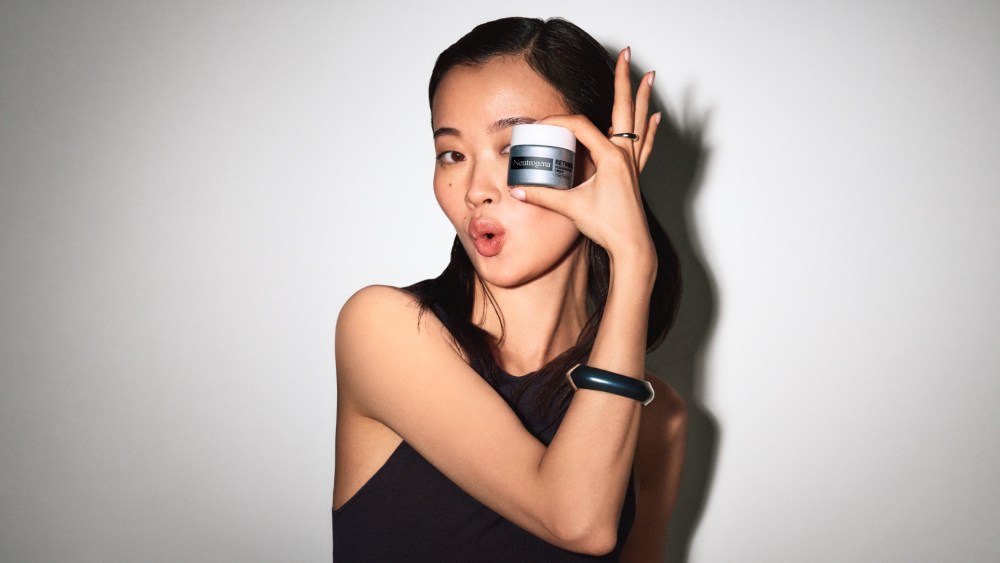

A decade shy of its centennial anniversary, Neutrogena is focused on reestablishing its authority in the rapidly expanding category of clinical and dermatologist-led skin care.
“We want to accelerate. We want to get to the next level. We want to unlock that value,” said Chris Riat, vice president of Neutrogena Global.
As part of its plan to do so, the heritage brand, originally launched in Los Angeles, is introducing its latest innovation, the Rapid Wrinkle Repair Retinol Regenerating Cream, alongside a new communications platform called Break the Rules. Made to debunk the myths and misinformation being fed to consumers today, Break the Rules will offer expert-backed advice and insight on a range of topics, including antiaging, while calling back to the efficacy of the products in Neutrogena’s portfolio.
“There’s a lot of voices, a lot of big signs out there,” Riat said. “With this campaign, our goal is to put our science at the forefront to anchor the benefit that we’re bringing into beauty.”
According to Riat, the platform will encourage consumers to evade virality and false compromises regarding formulas and routines that are often parroted in social conversations online, one of which being: a product must be either fragrance- or texture-free to yield visible results.
Retinol, specifically, is “full of compromises,” Riat said. “It’s the most researched ingredient in the category. It’s like 60,000 searches every month. Most of the time they are focused on this compromise that they want efficacy but at the same time you must manage irritation, and it’s always like this tension between the two,” he continued, calling the Rapid Wrinkle Repair Regenerating Cream a disrupter in the category. Designed to reverse seven years of visible skin aging, the cream, $24.97, uses patented control-release technology that delivers twice the retinol power, with additional ingredients, including vitamin A and hyaluronic acid.
Driving the market growth — and dermatologist-led skin care — is Gen Z, Riat pointed out. “They drive the influence,” he said. “Brands that are connecting well with Gen Z, they connect well with all age groups.”
Though Gen Z may have been “a bit of a blind spot” for Neutrogena in the past, the brand has been doubling down on the generation, launching buzzy campaigns with Danessa Myricks, ambassadorships with Joey King and Tate McRae (which garnered $790,000 in media impact value in one week) and major partnerships with Coachella Valley Music Festival and Lollapalooza.
As the market continues to swell, and the clinical category starts to get a little crowded, Neutrogena knows the race to be the first to new ingredients is essential in maintaining its heritage as a leading brand.
“Beauty is a category that never looks backwards; it’s always looking forward, searching for new innovation and the next new thing. That’s always how this category’s worked, and it’s also how we’ve been since the beginning,” Riat said. “Reality is that when Neutrogena was created, it was a cosmetic company, and we brought derm science to this. This fusion between the two is our edge, our DNA. That edge and that DNA has never been more relevant today.”
Both the product and platform launch come as Neutrogena is about to change hands as part of the sale of parent company Kenvue Inc. to Kimberly-Clark Corp., a deal valued at $48.7 billion and set to close later this year. While Neutrogena’s sales weren’t listed in Kenvue’s first quarter 2026 report, overall skin health and beauty sales jumped 8.4 percent from the prior-year period.
PakarPBN
A Private Blog Network (PBN) is a collection of websites that are controlled by a single individual or organization and used primarily to build backlinks to a “money site” in order to influence its ranking in search engines such as Google. The core idea behind a PBN is based on the importance of backlinks in Google’s ranking algorithm. Since Google views backlinks as signals of authority and trust, some website owners attempt to artificially create these signals through a controlled network of sites.
In a typical PBN setup, the owner acquires expired or aged domains that already have existing authority, backlinks, and history. These domains are rebuilt with new content and hosted separately, often using different IP addresses, hosting providers, themes, and ownership details to make them appear unrelated. Within the content published on these sites, links are strategically placed that point to the main website the owner wants to rank higher. By doing this, the owner attempts to pass link equity (also known as “link juice”) from the PBN sites to the target website.
The purpose of a PBN is to give the impression that the target website is naturally earning links from multiple independent sources. If done effectively, this can temporarily improve keyword rankings, increase organic visibility, and drive more traffic from search results.