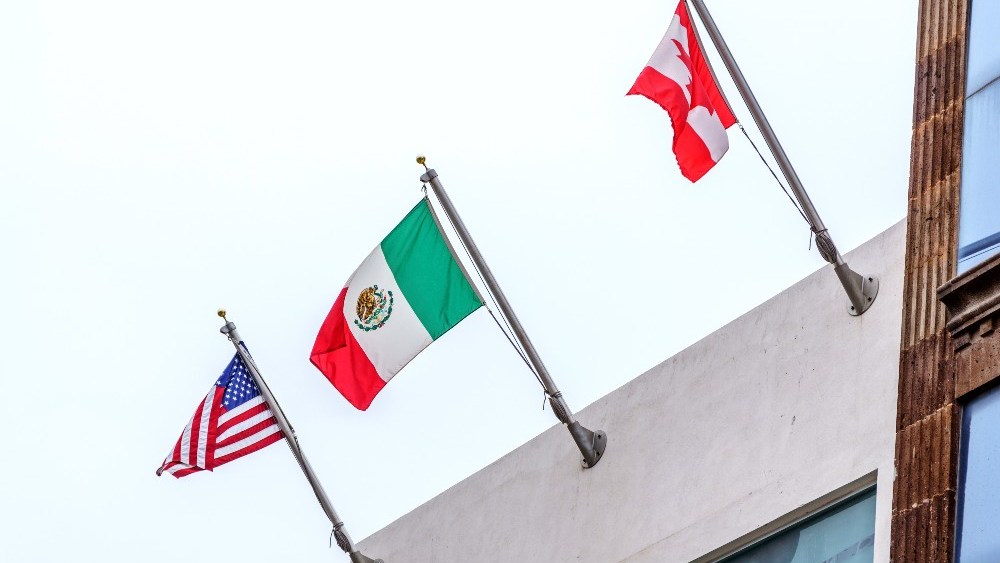

Trade negotiations between the United States and Mexico have reached an impasse after months of talks between officials about a deal to reduce duties on critical imports from beyond the southern border.
Objections from U.S. Commerce Secretary Howard Lutnick precipitated the breakdown, according to a report from the Wall Street Journal.
The two sides had been homing in on an agreement that would draw down American duties on steel, aluminum and cars in exchange for certain concessions from Mexico, and both Mexican officials and private sector executives were buoyant about the prospect of a deal.
This limited agreement, according to the outlet’s unnamed sources, would have cleared a path toward further discussions about the U.S.-Mexico-Canada Agreement (USMCA), which the U.S. declined to renew upon its six-year joint review over the summer.
Progress toward the interim deal began to lose momentum in recent days, the WSJ wrote, due to friction stemming from the 25 percent U.S. tariffs on cars and 50 percent duties on metals, which the Commerce Department is responsible for administering in the service of national security. Lutnick has been resistant to reducing the tariffs, the sources said.
Both sides have denied that negotiations had stalled, saying they’re still heavily engaged in talks.
The development calls into question the future of the USMCA, which will face annual reviews until 2036—or until one of the three partner nations decides to pull out.
It’s not the first time that Lutnick’s intervention has derailed a near-deal. In August, the U.S. and Canada were working toward an agreement based on lower U.S. tariff rates for metals and vehicles, but the Commerce Secretary objected to the scope of the arrangement. The collapse of those talks led to a trade war between the two countries, which have now hit each other with bilateral tariffs of up to 50 percent on more than $20 billion in exports.
U.S. Trade Representative Ambassador Jamieson Greer has promised interim trade agreements with both Canada and Mexico by year’s end that would involve drawing down duties on critical sectors as a means of deferring bigger conversations about rules of origin, labor and environmental protections until USMCA negotiations resume, but that now seems unlikely given the simmering tensions with Canada and the deflation of hopes for a speedy resolution with Mexico.
“Some of the biggest questions for 2027 remain unresolved. One is the North American partnership,” said Blake Harden, managing director of the Washington Council at Ernst & Young LLP, during a virtual roundtable on trade issues that took place Thursday.
“USMCA was not renewed in July, but it wasn’t terminated either, and it remains in force while the U.S. and Mexico negotiate. And some of those talks are expected to continue into 2027,” she said.
“North America itself has become a risk variable,” Sameer Anand, EY-Parthenon Americas supply chain leader, added. Pointing to the breakdown in both bilateral and collective USMCA talks, and the 50 percent duties on Canadian vehicles levied under Section 338 in August as a result of the devolution of that relationship, Anand said companies are likely to have to pivot away from long-term strategies made with the trade agreement in mind.
“What happens to Canadian vehicles and parts that are facing 50 percent tariffs, and what happens to auto companies that are thinking about adding capacity, but now they may change direction without a USMCA agreement?” he said. “A different choice needs to be made.” Unfortunately, though, with uncertainty still swirling, many companies are caught in a cycle of “decision lag.”
Harden added that while there is a “deep desire for policy certainty and stability” on the part of companies and corporations, they’ve also learned that they “just have to operate within” the uncertainty that is likely to persist into 2027.
PakarPBN
A Private Blog Network (PBN) is a collection of websites that are controlled by a single individual or organization and used primarily to build backlinks to a “money site” in order to influence its ranking in search engines such as Google. The core idea behind a PBN is based on the importance of backlinks in Google’s ranking algorithm. Since Google views backlinks as signals of authority and trust, some website owners attempt to artificially create these signals through a controlled network of sites.
In a typical PBN setup, the owner acquires expired or aged domains that already have existing authority, backlinks, and history. These domains are rebuilt with new content and hosted separately, often using different IP addresses, hosting providers, themes, and ownership details to make them appear unrelated. Within the content published on these sites, links are strategically placed that point to the main website the owner wants to rank higher. By doing this, the owner attempts to pass link equity (also known as “link juice”) from the PBN sites to the target website.
The purpose of a PBN is to give the impression that the target website is naturally earning links from multiple independent sources. If done effectively, this can temporarily improve keyword rankings, increase organic visibility, and drive more traffic from search results.
Streaming Film
Nonton Film gratis
Jasa Backlink
Download Anime Batch